Dave Eggers: "The Circle"

Sports Journalists Forum – Media, Newsroom & Reporting Talk

Help Support Sports Journalists Forum:

Dick Whitman

Well-Known Member
Joined
May 1, 2009
Messages
45,703
I don't know if it's a great novel. Or even a good one. But about a third of the way through it, I think it might be the most important novel written so far this century. A searing critique of social media, the plot involves a new employee at a Google/Facebook clone called the Circle.

It's not a subtle book, but it's jarring. And, as someone with my own love/hate relationship with the Internet, I think it's a novel we really needed. Some people, particularly Web evangelists, will hate it. Personally, I think it's our "1984." My own quickie take on social media is that it can be a force for good, but humanity seems incapable of using it that way, and I think it's inevitably a net negative for society.

I turn it over to one of Eggers's (concededly cardboard) characters:

"Your tools have elevated gossip, hearsay and conjecture to the level of valid, mainstream communication. ... Now the movie stars beg people to follow their Zing feeds. They send pleading messages asking everyone to smile at them. And holy ****, the mailing lists! Everyone's a junk mailer. You know how I spend an hour every day? Thinking of ways to unsubscribe to mailing lists without hurting anyone's feelings. There's the new neediness - it pervades everything. ...

"(T)he tools you guys create actually manufacture unnaturally extreme social needs. No one needs the level of contact you're purveying. It improves nothing. It's not nourishing. It's like snack food. ... You know how you finish a bag of chips and you hate yourself? You know you've done nothing good for yourself. That's the same feeling, and you know it is, after some digital binge. You feel wasted and hollow and diminished."

I know many will dismiss Eggers, like they do Jonathan Franzen, as a Luddite. I think that's lazy. I think social media's rise is a phenomenon that merits a discussion like this. Sure, TV didn't destroy us. But it's not in my kitchen. It's not in my kid's bedroom. We did pull back.
 
I read the NYTimes mag cover story, that was an adaptation from the book.

I thought it was great but I'm an Eggers-head.

Speaking of social media's negatives, follow @BestFansStLouis for some interesting takes.
 
Kate Losse says the book is stolen from her work:

http://www.theatlanticwire.com/technology/2013/09/did-dave-eggers-rewrite-kate-losses-book/69631/

https://theboykings.squarespace.com/tbk-the-circle
 
It's dumb for Eggers to say he didn't do any research. He had to have, to make the co
company seem real. That said, he stole nothing. He fictionalized Silicon Valley. I'm sure he got other details from other books and periodical pieces, as well.
 
One thing the novel really gets right is the critique of all-encompassing modern surveillance, particularly the way that we surrender our privacy without a second thought to Facebook, Google, Twitter, and the rest of them. There is an early scene in which one of the executives at the company shows off a new project at a corporate convocation in which tiny cameras will soon be anywhere and everywhere in the world. It's a little on-the-nose as social criticism because the crowd cheers wildly, with no skepticism or alarm apparent. On the other hand, I don't think that's too off-base as an observation of Silicon Valley corporate culture, from everything I've read, including a recent New Yorker piece about how it is pretty much an article of faith in the Valley that they are world-changers.

I finished a scene on the commute a couple minutes ago in which the new employee doesn't think twice that her medical records are completely available to the company's medical staff, and she wasn't even aware of it. It's not the only moment in the novel that is an allegory for how much information we willingly surrender to Mark Zuckerberg and the rest of them.

None of this is new information, mind you, but it's interesting to see it dramatized like this. Much more powerful than some polemic. This book, I think, is what movie critics so desperately wanted "The Social Network" to be, when really it was a legal thriller.
 
As an Amazon Associate we earn from qualifying purchases. Product prices and availability are accurate as of the date/time indicated and are subject to change.
While I doubt you enjoy the Nerd TV, last night's Marvel's Agents of Shield so completely nailed it.

The good guys were hunting a criminal type and they were going through Facebook, Instagram, Twitter, etc to get pictures from the crime scene and one commented that people were now doing surveillance on themselves.

That has nothing to do with the Eggers book, I just thought it was interesting.
 
JayFarrar said:
While I doubt you enjoy the Nerd TV, last night's Marvel's Agents of Shield so completely nailed it.

The good guys were hunting a criminal type and they were going through Facebook, Instagram, Twitter, etc to get pictures from the crime scene and one commented that people were now doing surveillance on themselves.

That has nothing to do with the Eggers book, I just thought it was interesting.

The NY Times recently had a story about how New York detectives were now using social media in place of stop-and-frisk. They'll "friend" gang members with accounts of fake hot girls, and these morons will gleefully accept the request without a second thought.

As far as the beginning of your post, the last three movies I've watched are "Superman" (1979 original), "Jurassic Park," and "Alien." So take that! :)
 
Scarier than social media, I think, are the ones who make the apps that we use -- Instagram, 4square, Tumblr, many others -- and to use them we surrender pretty much all of our information by giving them tons of "permissions".
 
A smart blue-state friend of a friend started this book, tossed it aside after 150 pages or so.

I'm glad to get a differing perspective here.
 
HejiraHenry said:
A smart blue-state friend of a friend started this book, tossed it aside after 150 pages or so.

I'm glad to get a differing perspective here.

There are a lot of reasons that people would dislike it. A lot of them are valid. The story itself isn't tremendous, though it might actually work better on screen. The characters are largely types. I can see where many would be put off by some of the on-the-nose speechifying. And even some of the material that is meant to be more subtle can be heavy-handed.

On top of all that, like I said, Internet evangelists are going to dislike it. In particular, social media evangelists are going to dislike it. And, I imagine, a lot of those people fall into your friend's demographic - smart people from blue states. One blue state in particular, I'd bet. They are often under attack as it is, from writers like Eggers and Franzen as well as polemecists like Jason Lanier, Sherry Tunkle, and Nicholas Carr. But they should engage in the conversation, instead of reflexively dismissing the other point of view.

Eggers holds a mirror up to How We Live today, and has produced a pretty comprehensive, incisive, and sweeping vision of it. And whatever ding you want to give it for lacking literary heft it more than makes up for in accessibility. In the right hands, the inevitable film could be a cultural touchstone. Or it could be "Bonfire of the Vanities" or "The Hunger Games." We'll see. But, for now, this is a really important novel that people should read.
 
****, this may not be your intention, but you're making it sound like The Jungle for our time. I can't imagine anyone reading The Jungle by choice today. With an "issue novel," once the reader's got the thesis, there needs to be something worth reading.
 
Tremendous satire:

"Mae hesitated briefly, knowing the gravity of what she was about to do - to come out against these rapists and murderers - but she needed to make a stand. An auto response thanked her, noting that she was the 24,726th person to send a smile to Ana Maria and the 19,282nd to send a frown to the paramilitaries."
 
**** Whitman said:
Tremendous satire:

"Mae hesitated briefly, knowing the gravity of what she was about to do - to come out against these rapists and murderers - but she needed to make a stand. An auto response thanked her, noting that she was the 24,726th person to send a smile to Ana Maria and the 19,282nd to send a frown to the paramilitaries."

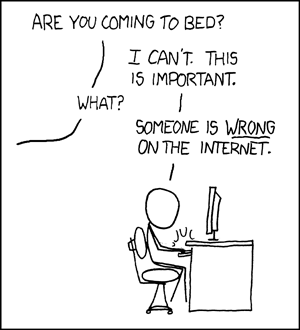
duty_calls.png
 
TheSportsPredictor said:
**** Whitman said:
Tremendous satire:

"Mae hesitated briefly, knowing the gravity of what she was about to do - to come out against these rapists and murderers - but she needed to make a stand. An auto response thanked her, noting that she was the 24,726th person to send a smile to Ana Maria and the 19,282nd to send a frown to the paramilitaries."

duty_calls.png

That was not meant as a rebuttal to watery tart.
 
My last engagement on a literary thread involved JR charging in mad at the world, not realizing I was snarking someone else.
 
Some of the oddest criticism I've seen of the novel, and it comes from a lot of tech blogs and techies writing otherwise, is that Eggers didn't get the Internet or tech companies "right," as if this undermines his overall vision. That, for example, the Circle's "Unified Operating System" wouldn't work in real life for this, that, or the other reason. That we don't see programmers writing code.

To me, this is akin to criticizing Woody Allen in "Midnight in Paris" or Stephen King in "11/22/63" for not sufficiently exploring the physics of time travel. In all three instances, the conceit is established and is really not relevant to the piece's larger explorations. It's a credit to Herman Melville that he got whaling right, I suppose. But I think it's a silly standard to hold a novel like this to. An tech conglomerate has become massive and indispensable. Period. End of story. The rest is details. In fact, I think even critiquing the novel as some futurist vision is the wrong approach. This is a satire of how we live today, not a specific warning about where we are headed, other than the very general observations about rampant multi-tasking, diminishing privacy and increasing neediness.
 
Here is Slate's Jessica Winter making that exact and inane criticism:

http://www.slate.com/articles/technology/books/2013/10/dave_eggers_tech_novel_the_circle_reviewed.html
 
**** Whitman said:
Here is Slate's Jessica Winter making that exact and inane criticism:

http://www.slate.com/articles/technology/books/2013/10/dave_eggers_tech_novel_the_circle_reviewed.html

I read that name and pictured this:

lucille-bluth-arrested-development-ifc-jessica-walter.jpg
 
Last edited by a moderator:
Has anyone else read it yet or started?

Here is a positive review on a tech site:

http://mashable.com/2013/10/18/tech-fiction-reading/

I finished it. The ending is a little rushed - it gets kind of hyper-dystopian. Eggers clearly wanted to take his set-up to its logical conclusion. I don't think he had to, but I don't think it was a terrible decision, either.

I'm really glad I took the time to read it. The book hits almost every criticism of the social media age that a lot of us probably wrestle with or feel uneasy about, but can't quite put our finger on.
 

Latest posts

Back
Top