shanny4055
New Member
- Joined
- Sep 23, 2010
- Messages
- 24
Vagas and me at the 2024 book signing at Notre Dame bookstore:Are ties required attire for all attending Notre Dame players/coaches/fans?
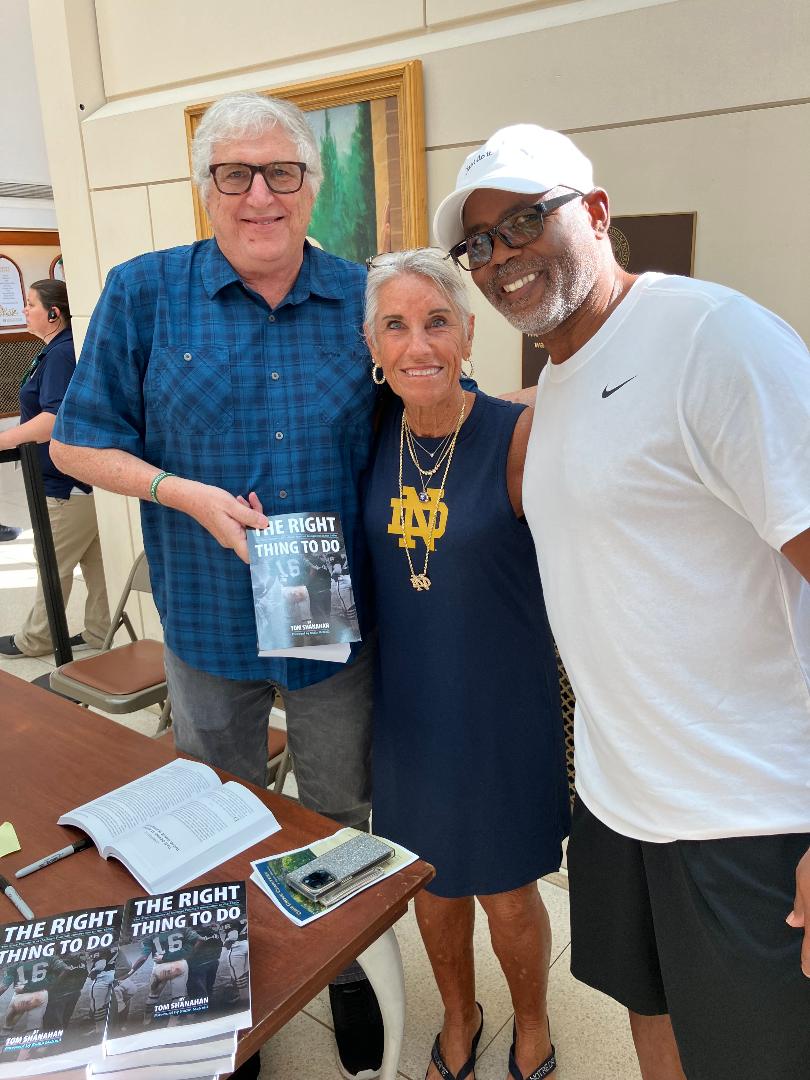

Vagas and me at the 2024 book signing at Notre Dame bookstore:Are ties required attire for all attending Notre Dame players/coaches/fans?
Yes. The game was so physical he says in THE RIGHT THING TO DO he was peeing blood after the game. HeWasn't Rocky Bleier also on that Notre Dame team?

A true Game of the Century requires buildup.
Ohio State was No. 1 until it was upset by Michigan on November 17, 1969. Not until then did No. 2 Texas and No. 3 Arkansas move up to 1-2.
Texas beat Notre Dame in the Cotton Bowl, but Arkansas lost to No. 13 Ole Miss in the Sugar Bowl.
Penn State, No. 2 in the final poll, finished 11-0 with an Orange Bowl in over No. 6 Missouri.

Yes.Wasn't Rocky Bleier also on that Notre Dame team?
It is a sign of my dementia that I forgot George Webster, who was the best player on the field that day. He was a rover at Michigan State which was basically their strong safety. In the NFL he was drafted by the Oilers and made first team All-AFL linebacker his first three years before he suffered an injury that basically ruined him.Two of 1966 Michigan State's College Football Hall of Famers were Bubba Smith as a 6-7, 285 DE and George Webster a 6-4, 245 Rover. They were taken 1st overall and 5th overall in the 1967 NFL draft.
Two of Notre Dame's College Football Hall of Famers were Alan Page as a 6-4, 245 DT and Jim Lynch LB 6-1, 235. They were selected 17th in the first round and in the second round. Lynch also won the Maxwell Award (the other Heisman), although he says in both of my books, RAYE OF LIGHT and THE RIGHT THING TO DO, and in THE BIGGEST GAME OF ALL that Webster should have won the 1966 Heisman (Steve Spurrier won it).

Minnesota had some success in the early 1960s by having black players before many of its contemporaries, too.Likely so. That undefeated team was the last hurrah before a mini-crash that saw Bama lose 17 games over the next four seasons, the final ones as an all-white team.
Michigan State did indeed find a gold mine of success in the 60s recruiting Southern blacks when few others would, at least at the volume the Spartans did.

“What puts a real Game of the Century over the top is when it’s got greater meaning or context – Michigan State coach Duffy Daugherty … he’s got 20 African American players, and he’s got Jimmy Raye as an African American quarterback.”Sorry, but you aren’t the arbiter of such things. There are many “Games of the Century” - which is a silly designation in the first place.
That said, AI is on my side. And you can’t argue with SkyNet.
View attachment 21529
Jimmy Jones played 1969-71. He was one of only four Black starters on USC's 1970 team that played Alabama. USC followed an unwritten quota limiting Black players to a half-dozen or so. There were only five Black players on the 1962 national title team and only seven on the 1967 national title team despite the diversity and population of Los Angeles.USC's first black quarterback under Coach John McKay was Jimmy Jones (1970). Some insiders insisted that McKay took so much **** over that, he would never have another black QB. Then in 1974, Pat Haden got his brain scrambled in a game at Pitt and he was replaced by ...... Vince Evans. At that time, people only knew the name, not the person. They were surprised that Vince Evans was black. Also on the team was a defensive lineman named Otis Page, who was white.
Minnesota only had five Black players on its 1960 national title team. Remember the unwritten quota limitations. Bobby Bell told me how he ended up at Minnesota. The story is told in THE RIGHT THING TO DO. Bell said North Carolina coach Jim Tatum saw him in the 1959 North Carolina Negro Shrine All-Star Game. Remember, segregation back then so there was a Shrine Game for White players and a Black Shrine Game. Tatum phoned his friend Minnesota coach Murray Warmath about Bell. Warmath wasn't interested in a player sight unseen. Tatum told he would pay Bell's scholarship if he didn't work out. Remember, this is 1959. Coaches didn't make anything more than a professor. After Bell's success on the freshmen team, Warmath asked him if he had any friends. He said yes, Carl Eller. That's how Eller ended up at Minnesota in 1960. Warmath didn't have another Black player from the South until Charlie Sanders in 1964.Minnesota had some success in the early 1960s by having black players before many of its contemporaries,
Jimmy Jones played 1969-71. He was one of only four Black starters on USC's 1970 team that played Alabama. USC followed an unwritten quota limiting Black players to a half-dozen or so. There were only five Black players on the 1962 national title team and only seven on the 1967 national title team despite the diversity and population of Los Angeles.
Minnesota's Sandy Stephens of Uniontown, PA., was the first Black quarterback to win a national title in 1960. Michigan State's Jimmy Raye, recruited out of segregated Fayetteville, N.C., aboard Duffy Daugherty's Underground Railroad, was the South's first Black quarterback to win a national title in 1965 and 1966.
Jimmy Jones stood on the shoulders of Sandy Stephens, Jimmy Raye and other Black players in the 1960s.
Three Black Teenagers Changed the Face of College Football and Got Written Out of History – Tom Shanahan Report
Both teams were still segregated rosters. That’s not America. Texas was the last all-White national champion.
Yes, by the late 1960s the quota system crumbled.Not challenging you, I figure you have quite a bit of documentation. But I have never heard of this quota system. I got to USC in 1972 and there were a lot more than 6 black players.
Thanks for keeping an open mind.Yes, by the late 1960s the quota system crumbled.
USC didn't have double-digit Black players until 1970. Of the 18 Black players on the 1970 roster, nine were junior college transfers and two were four-year school transfers. Since they were shedding their unwritten quota years, the only four starters in 1970 were junior QB Jimmy Jones, senior RB Clarence Davis, senior DL Charlie Weaver (a LB in NFL with Lions) and senior DL Tody Smith. Jones was a high school recruit, Davis and Weaver were in their second year as JC transfers, Smith was a four-year school transfer.
Initially, the increased recruitment of Black players rubbed returning White players the wrong way, according to Charle Young, a Black sophomore TE in 1970.
Untold story of racial divide on 1970 and 1971 USC football rosters that played Alabama – Tom Shanahan Report
You never heard of the unwritten quota limitations because it was the unwritten and in general the 1960s sports media avoided race for fear of alienating subscribers and advertisers. It's similar to the unwritten rule in basketball in those days -- start two Black players at home but three on the road (very few televised games in those days). The main reason you never heard it is the Bear Bryant fairytales are entrenched through sloppy journalism blinded by Bryant's legend.
Oh, I never said there is only one Game of the Century. I said there are about a half-dozen iterations.One, I submit that’s exactly what America was at that point in time.
Two, arguing about which game is the actual “Game of the Century” is as pointless as arguing who is the most beautiful woman to ever live. It’s impossible to declare a winner.
Three, newbs owe a round of drinks. Welcome aboard. I hope you’ll stick around.